Wednesday, November 26, 2014

Morality & Oxytocin

In previous posts I've talked about Oxytocin as one of our happy chemicals. And how using that, as opposed to dopamine, for dealing with difficult times in life is a healthier approach.
http://www.psychologytoday.com/blog/the-athletes-way/201211/the-neurochemicals-happiness

3. Oxytocin: “The Bonding Molecule” Oxytocin is a hormone directly linked to human bonding and increasing trust and loyalty.  In some studies, high levels of oxytocin have been correlated with romanticattachment. Some studies show if a couple is separated for a long period of time, the lack of physical contact reduces oxytocin and drives the feeling of longing to bond with that person again. But there is some debate as to whether oxytocin has the same effect on men as it does on women. In men, vasopressin (a close cousin to oxytocin) may actually be the “bonding molecule.” But again, the bottom line is that skin-to-skin contact, affection, love making and intimacy are key to feeling happy.

Paul Zak, a neuroeconomist, has done some fascinating studies involving oxytocin. This first video tells a story about a terminally ill boy and his father. Those listening to the story had increased levels of cortisol (stress hormone) and oxytocin (empathy). What was interesting was he found people to be more charitable with the increase in oxytocin.


Oxytocin is tied to trust. If you can produce more oxytocin, you'll be more trusting and trustworthy. And ultimately more happy.

This next video delves more into oxytocin and its relationship to morality. He makes a lot of fascinating points in the video, so just watch it. But one funny study he did was taking oxytocin levels at a wedding. I don't know who would have agreed to that! But he found super high oxytocin in people at the wedding in concentric circles around the bride. HA!


The take away from all of this? His simple solution for producing more oxytocin.... hugs. In fact he says 8 hugs a day. Simple enough. So next time you're having a bad day, instead of hopping on your phone for a dopamine hit, or indulging in some unhealthy habit... find someone to hug. 

Monday, November 24, 2014

Praising Ability vs Effort

http://www.brainpickings.org/2014/01/29/carol-dweck-mindset/

I have this book sitting at home, but haven't started it yet. I found this study to be particularly interesting and applicable.
Dweck and her colleagues gave each ten fairly challenging problems from a nonverbal IQ test, then praised the student for his or her performance — most had done pretty well. But they offered two types of praise: Some students were told “Wow, you got [X many] right. That’s a really good score. You must be smart at this,” while others, “Wow, you got [X many] right. That’s a really good score. You must have worked really hard.” In other words, some were praised for ability and others for effort. The findings, at this point, are unsurprising yet jarring:


What’s so alarming is that we took ordinary children and made them into liars, simply by telling them they were smart.

Monday, November 17, 2014

Guess I should start doing Yoga.....

This is another great explanation of the 'happy chemicals' our brains and bodies use to make us feel good.

http://www.psychologytoday.com/blog/the-athletes-way/201211/the-neurochemicals-happiness


One thing that stood out is the section on GABA. In the Sons of Helaman and Eternal Warriors classes, we learn how to use GABA to control our limbic system, so we can stick to our goals and values.  It's interesting to see that Yoga can help us produce GABA as well. This goes along well with one of my previous posts on using meditation to 'fire up the left frontal lobe', where happiness resides. So I guess i should take up yoga and meditation to help in staying prefrontal :)

5. GABA: “The Anti-Anxiety Molecule” GABA is an inhibitory molecule that slows down the firing of neurons and creates a sense of calmness. You can increase GABA naturally by practicing yoga,meditation or “The Relaxation Response.”  Benzodiazepines (Such as Valium and Xanax) are sedatives that work as anti-anxiety medication by increasing GABA. These drugs have many side effects and risks of dependency but are still widely prescribed. 
A study from the "Journal of Alternative and Complementary Medicine" found a 27% increase in GABA levels among yoga practitioners after a 60-minute yoga session when compared against participants who read a book for 60 minutes. The study suggests yoga might increase GABA levels naturally.

Sunday, November 2, 2014

'Cause you've had a bad day...'


Just a clarification right up front. I like donuts... this isn't a rip on donuts post. Nor ripping on the company that put up the ad. BUT, sometimes there's sneaky messages (especially from advertising and politicians) that you notice when paying attention... Are donuts really a good place to go for handling a bad day and bad emotions?


In the Eternal Warriors class you learn about the build up of negative feelings and how that leaves you susceptible to temptations to alleviate the pain. When you've had a bad day, do you turn to things that are contrary to your values (I value a healthy diet, but I FEEL like eating a whole package of oreos)? Do you turn to short term fixes, that leave you feeling more empty after (dopamine)? This donut could be replaced with drugs, video games, porn, sugar... or my favorite. Mountain Dew :)


Watch for messages encouraging you to listen with your limbic ears, rather than your prefrontal lobe. 
:)

Thursday, October 30, 2014

Science of Happy

https://www.lds.org/church/news/the-surprising-science-behind-supremely-happy-people?lang=eng&cid=facebook-shared


“Through MRI technology over the last 10 years, brain scans have become absolutely wonderful,” said Brother Smith. “Your frontal lobe is where happiness is located.” When someone is really sad, the right side of the frontal lobe lights up. And when someone is happy, the left part of the frontal lobe lights up. Happiness and sadness occur in different places of the brain.
Speaking about things that help the left frontal lobe come alive, Brother Smith said, “Meditation will fire up the left frontal lobe and flood your brain with dopamine.” There are 100 billion neurons in a person’s brain, and they talk to each other. To talk to each other they need neurotransmitters or chemicals. The three that make a person happy are norepinephrine, serotonin, and dopamine. Low levels of these chemicals may make a person unhappy. Returning them to normal levels may help some people.

I was reading a book called Mindsight, that talks about some of this neuroscience. In an oversimplified explanation, feelings  generated by the limbic system move through the right side of the brain, to the left. It's interesting that happiness would be in the prefrontal cortex. So many of the negative emotions that leave us susceptible to temptation come from the limbic system, overriding our higher cortical thinking.

Wednesday, October 29, 2014

Brains, Technology & Dopamine

Here's a follow up article on the same topic of dopamine...

http://www.glennbeck.com/2014/07/29/what-happens-to-our-brains-when-we-become-dependent-on-technology/

“We know that just like alcohol, gambling, nicotine that we know our cell phones release a burst of dopamine.  And so again a little bit of alcohol is fine too much alcohol is what’s dangerous.  Some gambling is fine.  Too much is dangerous.  Our cell phones are great they’re wonderful machines, but out of balance like all addiction, eventually we will waste resources, waste time and destroy relationships,” Simon said.
Have you ever seen a couple out at a restaurant where both people are on their phones and ignoring one another? That’s a sign of an unhealthy addition to technology.
 (Smart phones) have addictive qualities and so the concern is that, as teenagers, as they go through adolescence, like alcohol, they have social media and they have their phones and theyaccidentally are forming neural connections, where when they’re going through times of stress and they should be relying on each other, they are turning to machines,” Simon said.
The fear is that that will develop to addictions and it will exaggerate as we move forward into time.  We are already starting to see a rise in suicides, for example.  I mean, this affects all generations,” he added. ”  The CDC announced about a year ago that more Boomers now die from suicide than car accidents.  In other words, what we’re seeing is a rise of loneliness and isolation.  No one kills themselves when they are hungry.  We kill ourselves when we’re lonely.  In the 1960s, there were one school shooting.  In the 1980s, there were 27.  In the 1990s, there were 58.  In the past decade, there have been over 120.  It has nothing to do with guns.  It has to do with people feeling lonely.”
“The gun lobby and the anti-gun lobby, however they want to define themselves, would best serve society instead of throwing rocks at each other sat, down together and figure out how do we combat the loneliness that people are feeling. 70 percent of the school shooters were born after the year 1980, most of them are about 15 years old.  All of them attacked people within their own community and attack the people they blamed responsible for their own loneliness.”
“I may hug you,” Glenn said. “Thank you for actually saying that.  Something is missing in us.  There have been guns forever.  A kid in the 1960s could go and buy a gun, they didn’t use it.”
“Just recently UC Santa Barbara the shootings there, that kid may made those horribly chilling videos. He felt lonely and isolated because he was a virgin and he sought to find comfort on online support groups.  There is no online support group that can give you the same warmth and comfort and security than real, human, loving relationships.  And you see it’s chilling how he makes this video, how he’s excited, he’s actually excited to go shoot up the sorority, the people he blames for his sense of loneliness and isolation, because it’s the first time he feels a sense of control over his own life,” Simon added.
Simon pointed to the Twelve Step program for alcoholics, and how the final step is help another alcoholic, as an example of the importance of human relationships.
You know, we have an entire on the bookshelf called self-help we have no section on the bookshelf called help others.  We have become all about ourselves and yet the amazing thing if you want to find the job you love, help somebody find the job they love.  If you want to find somebody they love, help someone who is looking for love.  If you want do find happiness, help somebody else who is looking.  That’s how we do it.  And it feels so good when we do that that it actually encourages us to want to do it more.  We are built for service and when we create — this is the point of leadership.  When we create environments in which we feel safe amongst each other we will look after each other, when we create environments in which we fear each other, we will work to our own interests, we will being paranoid, cynical mistrustful of leadership, and it’s a lonely existence,” Simon said.

What's your 'go to' happy chemical?

This is an interesting article on some of the 'feel good' chemicals our brain produces.


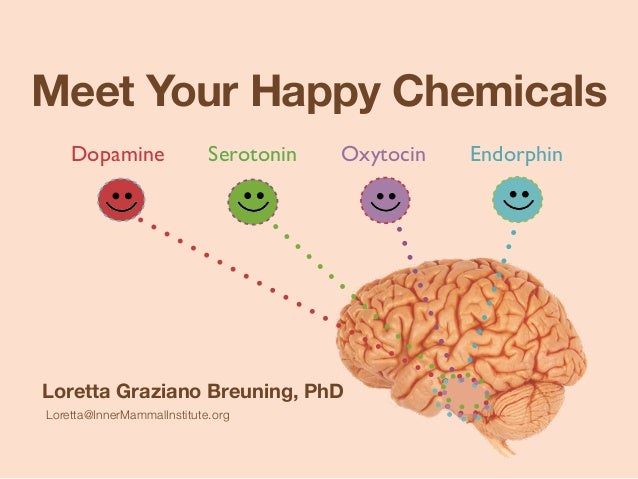
So in our brains, in our bodies, there is a system of chemical rewards so when we do things we get a feeling of doing those things that is designed to reward behavior that is in our best interest.  There’s four chemicals that are mainly responsible for all the good feelings that we would have,” Simon explained. “So any kinds of feelings of happiness, joy, success, friendship, trust, love, loyalty can basically be boiled down to endorphins, dopamine, serotonin, and oxytocin.”


Simon explained, “Dopamine is something you get when you accomplish something you set out do accomplish so that feeling when you get when you cross off something off your to do list the feeling find something on Google or eBay.  Nobody goes to Google and types in things you’re not looking for.  We have something in mind.  We type it in and the feeling of there it is, that’s dopamine.  Dopamine is also the feeling you get when you win the game.  Yes, that sort of fantastic, we did it.  Or when you feel like you’re making progress.  So that’s why they put mile-markers — if you ran a race without mile-markers it’s actually unnerving so dopamine helps us feel like we’re making progress.  It’s the reason we’re achievement machines.”
“The problem with dopamine is it doesn’t last.  It comes in hits,” he said. 
While dopamine doesn’t last and leave people with strong feelings of accomplishment, the chemicals serotonin and oxytocin are what do last and are what Simon calls “social chemicals”.
“This is the importance — what you’re talking about is the solution to the imbalance of dopamine.  Right?  Which is these other beautiful, beautiful chemicals called serotonin and oxytocin.  Broadly speaking these two chemicals are the selfless chemicals.  They are the social chemicals.  These are the chemicals that reward us — it’s the feeling of trust.  It’s the feeling offriendship.  It’s the reason we like spending time with our friends.  It’s the reason we’d rather sit next to someone that we know and we leave a blank space at the movies because we don’t want to sit next to somebody we don’t know.  That feeling of safety.  That comes from these other two beautiful chemicals and the most important thing about those chemicals is they last.  They take a while to build up.  It takes time to build up trust, but they last,” he said. 
Now the great thing about serotonin — one of the ways in which we get oxytocin — and there’s a whole bunch.  Oxytocin is the warm and fuzzies.  One of the ways we get it is generosityActs of kindness.  Giving of your time and energy with no expectation of return.  Money doesn’t count.  Time and energy,” he explained.
Simon explained that if he goes online and donates a $1,000 to charity, he gets a very different feeling than if he spent a whole weekend afternoon painting a school. While a $1,000 may go further than his physical labor, it is a different mental reward.


When we're having a difficult moment, dopamine is a fast, easy treatment, but doesn't last very long. There's nothing wrong with dopamine, but if it becomes the long term strategy for dealing with emotional pain, we'll find ourselves back in the same situation very quickly. Not to mention we're following a pattern that can lead to turning to addictive sources of dopamine (porn, drugs etc).

My dad's best friend growing up was the local pin ball champ of the small town where they were growing up. Old timers didn't like him 'wasting his time' on things like that. They seemed to sense that the level of involvement wasn't healthy, even if they didn't know the science behind it. I suspect he was getting dopamine hits that were helping him deal with issues from his family. Soon it went from pinball into porn, and later to drugs.

Activities that produce dopamine aren't bad, but I think it's helpful to keep in mind what happens if we don't moderate, or if we're using dopamine for emotional comfort. IMHO a better solution, where possible would be to do service and to interact with loved ones. This will lead to closer interpersonal connections and helps keep your prefrontal cortex in charge of your life.